Selected Work

Content built for B2B and retail technology buyers: thought leadership, case studies and the editorial strategy behind them. A curated selection, from ghostwritten blogs to customer stories.

What is Conversational Analytics for Retail? How to Analyze Campaign Performance with AI

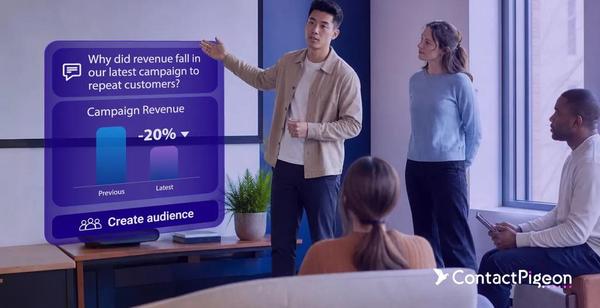
Campaign reports give marketing leaders plenty to discuss: revenue, purchase rates, average order value. The harder questions often come afterward. Why did an audience respond differently, and should that change the next campaign? Conversational analytics lets retail teams pursue those questions through natural-language queries and follow-ups, with evidence they can examine as the discussion develops.

For a CMO or CRM Director, the value lies in how that changes campaign planning. If fewer recipients bought, increasing the discount may be the wrong response.

Decision supported: whether a campaign report should change the next campaign.
Buyer: CMO, CRM Director.


AI Agents for Christmas & Holiday Shopping: How to Understand Customer Intent

A customer who explored gifts last week may be checking delivery deadlines today and shopping for a different recipient tomorrow. Their earlier activity remains useful context, but it cannot explain every subsequent visit. A recommendation based on the first task can become irrelevant before the Christmas campaign finishes running. For eCommerce and CRM teams, interpreting holiday shopping intent means establishing what the customer needs now, then updating the experience as new evidence arrives.

Decision supported: how to read shifting holiday intent before peak week.
Buyer: Head of Ecommerce, CRM Lead.

BFCM Metrics: What to Measure Before and After the Sale

Choosing your BFCM metrics before Black Friday and Cyber Monday gives your team a clearer way to evaluate the sale. When the orders arrive, you can check how much profit they generated, which customer groups responded, and what it cost to acquire a first-time buyer. As returns and repeat purchases become visible, you can build on that first review and decide which offers and parts of the retail customer journey deserve further investment.


Those answers depend on what you record before launch. Inconsistent sales definitions or shifting customer groups make results harder to explain, so a shared measurement plan gives finance, ecommerce and CRM a common starting point.

Decision supported: which metrics define success before the sale starts.
Buyer: CMO, Ecommerce Director.

How AI Promotion Optimization Helps Retailers Protect Peak-Season Margin

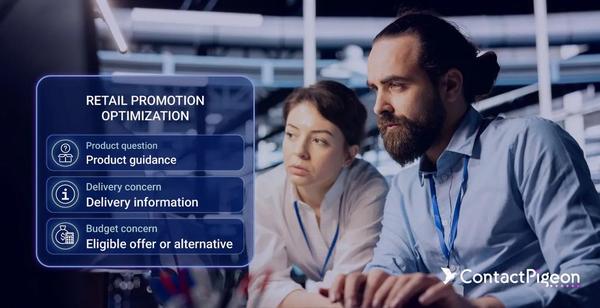
Retail promotion optimization starts with understanding what is preventing a purchase. A shopper asks whether a jacket is waterproof. Another needs reassurance about delivery. A third says the price is beyond their budget. A BFCM promotion strategy that gives all three an extra 10% off spends margin before establishing what would help each shopper buy.


For commercial, merchandising, and CRM teams, the practical task is to connect those capabilities to the economics of an offer. This article explains how to review a single promotion, work out what its discount must recover, and test whether guidance, follow-up or an incentive produces the better commercial outcome.

Decision supported: where a discount protects margin and where it gives it away.
Buyer: Ecommerce Director, Merchandising Lead.

What Retail AI Agents Actually Cost: A Practical TCO Model

How much does a retail AI agent cost?” sounds like a straightforward procurement question. In practice, the software price is only one part of the answer. For teams choosing retail AI agents, the real cost extends across implementation, data preparation, integrations, AI consumption, governance, monitoring, optimization, and the internal teams responsible for keeping the system useful after launch. This distinction becomes particularly important as AI agents move from isolated experiments into production.

Decision supported: what a retail AI agent costs to run, in a form finance will accept.
Buyer: CFO, CIO, Procurement.

What Breaks First: Stress-Testing Retail AI Agent Scalability for BFCM

Nearly a third of retailers hit a critical outage every week. Retail AI agent scalability is usually where that risk shows up first, because the retail AI stack sits on top of every other system that can fail. When an outage happens, 60% of engineering teams lose at least a fifth of their time responding to it, and 14% lose half or more. That is not only a revenue number. That is roadmap time already committed to something else, pulled away without warning.


None of this is a future problem. AI driven traffic to retail sites grew 693% year over year during the 2025 holiday season, and that growth curve does not pause for infrastructure to catch up.

Decision supported: whether the AI agent holds under BFCM traffic.
Buyer: CTO, Head of Ecommerce.

Pop Mart Marketing Strategy: How the Chinese Retailer Dominated Designer Toys

Every commercial team eventually meets the same problem in some form. Something works. A product, a campaign, a partnership, a moment of attention nobody engineered, and the traffic arrives faster than the systems built to hold it. Six months later, the traffic is gone, and the only durable record of it is a spike in a chart, because nothing in the stack turned those buyers into people the business could recognise a second time. The Pop Mart marketing strategy is the largest recent example of that problem.

Decision supported: which parts of a proven playbook a commercial team can repeat.
Buyer: CMO, Growth Lead.

The Top 20 Highest-Rated Customer Data Platforms in G2

In today’s digital landscape, Customer Data Platforms (CDPs) have become mission-critical tools for retail and marketing executives looking to stay competitive. In 2025, the ability to unify customer data, activate real-time personalization, and comply with tightening privacy regulations isn’t a luxury—it’s a strategic necessity. Whether you’re overseeing multi-brand operations or driving digital transformation in retail, the right CDP can unlock scalable growth and deeper customer loyalty.


T...

Top Trends Driving the Toys & Games Industry in 2025

The toys & games industry is undergoing a dynamic transformation in 2025, driven by rapid tech innovation, growing environmental awareness, and evolving consumer expectations. From AI-powered playmates to immersive AR/VR experiences, the market is adapting faster than ever to keep up with what kids (and adults!) want. As sustainability becomes non-negotiable and digital interactivity takes center stage, brands must stay ahead of these shifts to remain competitive. Understanding the top toys & ga...

How to Become an AI Email Marketing Specialist: A Guide to Optimize Your Career Path

In 2025, the role of an AI email marketing specialist is evolving as automation, predictive analytics, and hyper-personalization redefine how brands connect with their audiences. With nearly four out of five businesses relying on email marketing, the demand for skilled professionals who can leverage AI to enhance performance is growing. Additionally, half of marketers still consider email their most powerful channel, making it crucial for an email marketer to master AI-driven automation and data...